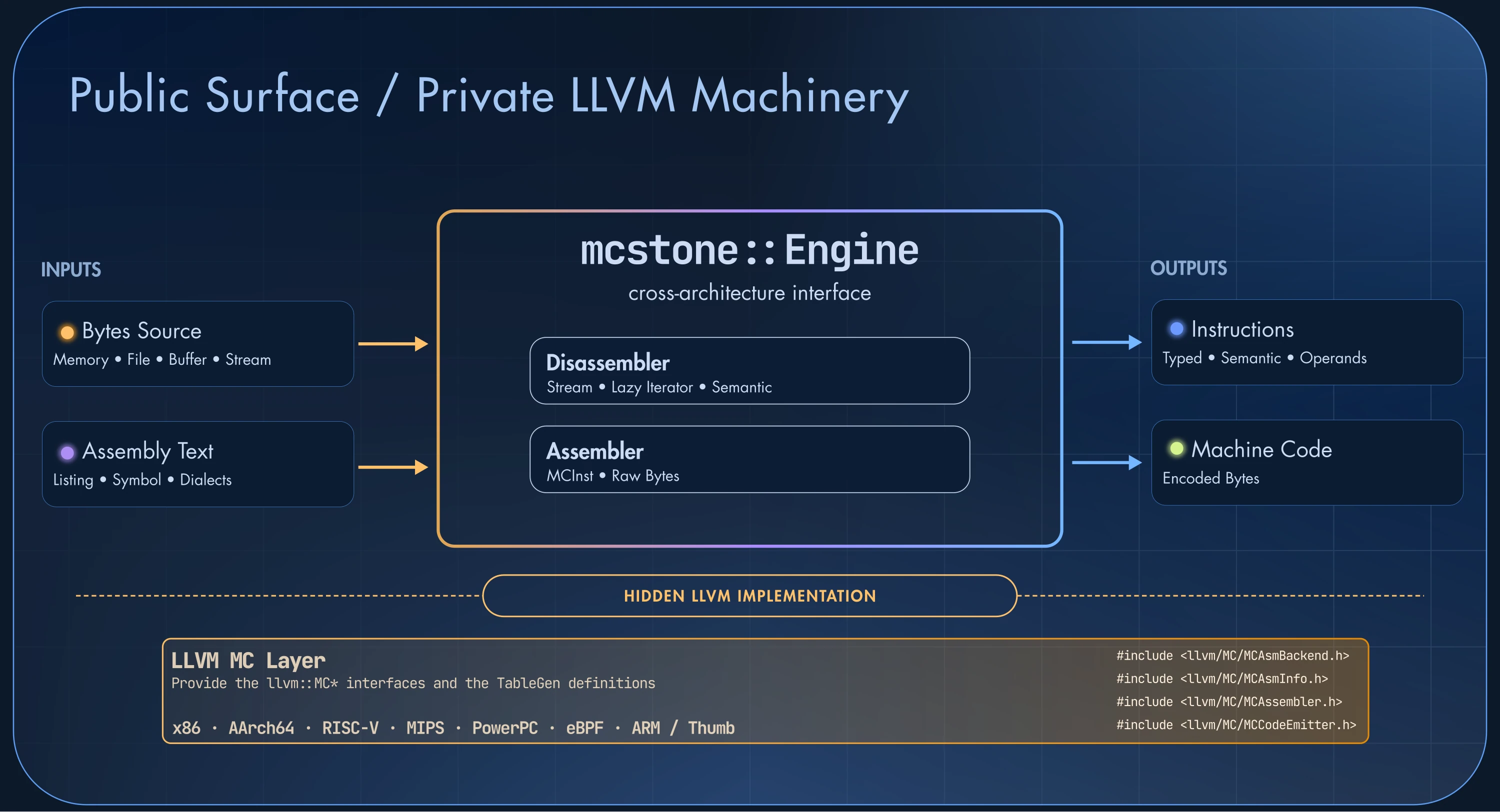
MCStone is an assembler and disassembler built directly on LLVM’s MC layer. It exposes a modern C++ API to disassemble streams of bytes and to assemble text listings. It ships instruction and operand models for x86, x86-64, AArch64, RISC-V, MIPS, PowerPC, and eBPF, plus ARM and Thumb at the instruction level.
LLVM provides a strong and reliable engine to assemble and disassemble code for
many architectures. Nevertheless, its llvm::MCDisassembler API is not easy to
interface with: it requires instantiating a bunch of other llvm::MC*
objects first, each with its own lifetime and configuration:
#include <llvm/MC/MCDisassembler/MCDisassembler.h>

std::unique_ptr<llvm::MCSubtargetInfo> MSI{target->createMCSubtargetInfo(
    /*TheTriple=*/*triple,
    /*CPU=*/details.cpu,
    /*Features=*/SF.getString()
)};

auto MC = std::make_unique<llvm::MCContext>(
  *triple, MAI.get(), MRI.get(), MSI.get(), SrcMgr.get(), MTO.get());

std::unique_ptr<llvm::MCDisassembler> MD{target->createMCDisassembler(*MSI, *MC)};
The purpose of MCStone is to absorb all this boilerplate and to keep the LLVM implementation private to the library, while exposing a user-friendly API that covers most reverse-engineering and binary analysis use cases.
Disassembly: Streams and Iterators
The cross-architecture decoding and encoding logic itself comes from LLVM and its TableGen definitions. MCStone does not reimplement it.
From an API perspective, llvm::MCDisassembler takes a sized buffer of bytes as
input and emits a llvm::MCInst. For instance, cmp byte ptr [rip + 4901546], 0 is
decoded as follows:
# encoding: [0x80,0x3d,0xaa,0xca,0x4a,0x00,0x00]
cmp     byte ptr [rip + 4901546], 0
                                # <MCInst #1335 CMP8mi
                                #  <MCOperand Reg:RIP>
                                #  <MCOperand Imm:1>
                                #  <MCOperand Reg:>
                                #  <MCOperand Imm:4901546>
                                #  <MCOperand Reg:>
                                #  <MCOperand Imm:0>>
MCStone uses this low-level API as a primitive and builds two facilities on top of it:
- Streams
- Lazy iterators
Streams
llvm::MCDisassembler takes a sized buffer as input. In many reverse-engineering
situations, we don’t (exactly) know the boundaries of the bytes we want to
disassemble. This happens, for instance, when disassembling a function directly
from memory:
auto anti_hook_ptr = imagebase + 0x40090;
auto instructions = engine->disassemble(anti_hook_ptr);
To address this practical need, the MCStone disassembly API abstracts its input behind a stream:
namespace mcstone {
class Engine {
  public:
  // [...]

  // Disassemble a non-owning stream
  instructions_it disassemble(Stream& stream, uint64_t addr);

  // Disassemble the given stream and take its ownership
  instructions_it disassemble(std::unique_ptr<Stream> stream, uint64_t addr);

  // Disassemble the memory of the current process, starting at addr
  instructions_it disassemble(uint64_t addr);
};
}
A Stream can be bounded by a size, but the user is also free to create an
unbounded stream when this size is unknown. This is what the address-only
overload does with a MemoryStream: bytes are read on demand from the process
memory.
Regular functions that take a pointer and a size, or a std::vector<uint8_t>,
are also exposed. They wrap their input in a non-owning RefStream:
 1namespace mcstone {
 2class Engine {
 3  public:
 4  // [...]
 5
 6  // Disassemble a non-owning stream
 7  instructions_it disassemble(Stream& stream, uint64_t addr);
 8
 9  // Disassemble the given stream and take its ownership
10  instructions_it disassemble(std::unique_ptr<Stream> stream, uint64_t addr);
11
12  // Disassemble the memory of the current process, starting at addr
13  instructions_it disassemble(uint64_t addr);
14
15  instructions_it disassemble(const uint8_t* buffer, size_t size, uint64_t addr);
16
17  instructions_it disassemble(std::vector<uint8_t> bytes, uint64_t addr);
18};
19}
Lazy iterators
MCStone disassembles streams by returning an iterator range: instructions_it.
Calling disassemble(...) positions the iterator on the first instruction and
stops there. Nothing else is decoded until the user advances it.
#include <mcstone/mcstone.hpp>

using namespace mcstone;

std::vector<uint8_t> get_bytes();

int main() {
  auto engine = Engine::create(Engine::Platform::LINUX,
                               Engine::Architecture::X86_64);

  // Only the first instruction has been decoded at this point
  auto instructions = engine->disassemble(get_bytes(), /*address=*/0x1000);
  return 0;
}
Therefore, the user only pays the memory and runtime cost of the
instructions that are consumed. This matters when the goal is to find a
specific set of instructions (e.g. syscalls) within a multi-gigabyte buffer, or
to stop at the first ret of a function whose size is unknown.
As mentioned in the introduction, llvm::MCDisassembler emits llvm::MCInst
objects to represent the decoded instructions. This representation is not
user-friendly from an instruction-analysis perspective. So in addition to lazily
decoding the stream, the iterator yields a mcstone::Instruction that is
specialized for each supported architecture:
#include <mcstone/mcstone.hpp>

using namespace mcstone;

std::vector<uint8_t> get_bytes();

int main() {
  auto engine = Engine::create(Engine::Platform::LINUX,
                               Engine::Architecture::X86_64);

  auto instructions = engine->disassemble(get_bytes(), /*address=*/0x1000);

  for (const mcstone::Instruction& inst : instructions) {
    std::println("{} | {}", inst, inst.is_syscall());
  }
  return 0;
}
Operands
Given a handle on an mcstone::Instruction, the natural next step is to inspect
its operands. llvm::MCInst exposes raw operands through llvm::MCOperand,
but these operands do not carry the original semantics.
For instance, the MCInst representation of ldrb w0, [x1, x2] has these
operands:
ldrb    w0, [x1, x2]                    // encoding: [0x20,0x68,0x62,0x38]
                                        // <MCInst #5035 LDRBBroX
                                        //  <MCOperand Reg:W0>
                                        //  <MCOperand Reg:X1>
                                        //  <MCOperand Reg:X2>
                                        //  <MCOperand Imm:0>
                                        //  <MCOperand Imm:0>>
The memory operand [x1, x2] is scattered across the last four operands, and
none of them describes the structure of the memory address.
MCStone fills this gap with a lazily evaluated iterator over the operands that reconstructs their higher-level semantics:
std::unique_ptr<mcstone::Instruction> I = get_inst("ldrb  w0, [x1, x2]");
const auto& arm64 = *I->cast<mcstone::aarch64::Instruction>();

std::println("{}", arm64);

for (size_t idx = 0; const auto& op : arm64.operands()) {
  std::println("  [{}]: {}", ++idx, *op);
  if (const auto* mem = op->as<mcstone::aarch64::Memory>()) {
    std::println("Base: {}", get_register_name(mem->base()));
    std::visit(overloaded{
      [](int64_t offset) {
        std::println("Offset (imm): {}", offset);
      },
      [](mcstone::aarch64::REG reg) {
        std::println("Offset (reg): {}", get_register_name(reg));
      },
      [](std::monostate) {},
    }, mem->offset());
  }
}
This code generates the following output:
0x000000: ldrb w0, [x1, x2]
  [1]: W0
  [2]: [x1, x2]
    Base: X1
    Offset (reg): X2
arm64.operands() yields only two operands. The second one is an
mcstone::aarch64::Memory instance that exposes the base register, the offset
(an immediate or a register), and the shift or extension of the memory access.
This semantic-aware operand iterator is what we need to analyze instruction
operands accurately. MCStone still relies on the original llvm::MCOperand
values, but with an extra layer of processing on top.
Please note that this operand processing is only performed when the
operands() iterator is consumed. Users don’t pay this cost unless they iterate
over it.
Ranges and Views
Beyond the performance aspect, lazily evaluated iterators have an interesting property when combined with C++ ranges. Users can create a view of what they intend to observe:
auto engine = mcstone::Engine::from_process();
auto insts = engine->disassemble((uintptr_t)&sensitive_function);
auto insts_view = insts |
    std::views::take_while([](const auto& I) { return !I->is_return(); }) |
    std::views::transform([](const auto& I) { return I->to_string(); });
This insts_view is just a view of the instructions before the first ret,
transformed into their textual representation. To effectively disassemble
and observe these instructions, we must iterate over the view:
for (const std::string& inst_str : insts_view) {
  std::println("{}", inst_str);
}
$ ./run
0x7f042cdbec60: push rax
0x7f042cdbec61: mov qword ptr [rsp], rdi
0x7f042cdbec65: inc qword ptr [rip + 0xfaec]
0x7f042cdbec6c: mov rax, qword ptr [rip + 0xe695]
0x7f042cdbec73: mov qword ptr [rax], rdi
0x7f042cdbec76: mov rax, qword ptr [rip + 0xe693]
0x7f042cdbec7d: mov rdi, qword ptr [rax]
0x7f042cdbec80: lea rdx, [rip - 0x7020]
0x7f042cdbec87: mov rcx, rsp
0x7f042cdbec8a: mov esi, 0x9
0x7f042cdbec8f: call 0xcc0c
0x7f042cdbec94: pop rax
The interesting aspect of this view is that it can be observed again later. The range reads the process memory each time it is traversed. So if the underlying code uses some kind of polymorphic protection, or if an attacker hooks the function, the same code observes the change:
auto engine = mcstone::Engine::from_process();
auto insts = engine->disassemble((uintptr_t)&sensitive_function);
auto insts_view = insts |
    std::views::take_while([](const auto& I) { return !I->is_return(); }) |
    std::views::transform([](const auto& I) { return I->to_string(); });

std::println("Before hooking:");

for (const std::string& inst_str : insts_view) {
  std::println("{}", inst_str);
}

hooky.hook((uintptr_t)&sensitive_function,
  [] (hooky::Engine&, hooky::HookingContext& ctx, bool is_enter) {
    if (is_enter) {
      std::println("Who: {}", (const char*)ctx.cpu.rdi);
    }
  });

std::println("After hooking:");

for (const std::string& inst_str : insts_view) {
  std::println("{}", inst_str);
}
$ ./run
Before hooking:
0x7f042cdbec60: push rax
0x7f042cdbec61: mov qword ptr [rsp], rdi
0x7f042cdbec65: inc qword ptr [rip + 0xfaec]
0x7f042cdbec6c: mov rax, qword ptr [rip + 0xe695]
0x7f042cdbec73: mov qword ptr [rax], rdi
0x7f042cdbec76: mov rax, qword ptr [rip + 0xe693]
0x7f042cdbec7d: mov rdi, qword ptr [rax]
0x7f042cdbec80: lea rdx, [rip - 0x7020]
0x7f042cdbec87: mov rcx, rsp
0x7f042cdbec8a: mov esi, 0x9
0x7f042cdbec8f: call 0xcc0c
0x7f042cdbec94: pop rax

After hooking:
0x7f042cdbec60: jmp qword ptr [rip]
0x7f042cdbec66: sbb al, 0x60
0x7f042cdbec68: shr byte ptr [rsp + rax], cl
0x7f042cdbec6b: jg 0x0
0x7f042cdbec6d: add byte ptr [rax - 0x6f6f6f70], dl
0x7f042cdbec73: nop
0x7f042cdbec74: nop
[...]
Same view, different runtime observation.
Assembly
The same Engine also assembles. It takes a text listing and returns the
encoded bytes, which makes round trips between text and machine code simple:
auto engine = Engine::create(Engine::Platform::LINUX,
                             Engine::Architecture::ARM64);

std::vector<uint8_t> raw = engine->assemble(R"asm(
  mov x16, x0;
  mov x17, x1;
)asm");

for (const auto& inst : engine->disassemble(raw, /*addr=*/0)) {
  std::println("{}", *inst);
}
On x86, the assembler supports both the Intel and AT&T dialects. Symbols are
resolved through an AssemblerConfig callback, and an existing llvm::MCInst
can be re-encoded directly. This last point is what allows, for instance,
x86::Instruction::lock() to return a copy of an instruction re-encoded with a
LOCK prefix.
MCStone compared to Capstone & Zydis
MCStone shares the same foundation as Capstone: both decode instructions with the tables that LLVM generates from its TableGen definitions. Capstone uses its own generated copy of these tables for each architecture, while MCStone links against upstream LLVM (23.1.0 at the time of writing). New instruction set extensions, decoder fixes, and the assembler side all land with each LLVM release. Zydis is a different design: a hand-written, dependency-free x86 and x86-64 decoder, and the throughput reference of this benchmark.
The numbers below come from the MCStone benchmark. Every engine uses
the same corpus: the first 16 MiB of the .text section of
libLLVM.so.22.1, about 3.7 million x86-64 instructions. The three libraries are built
by the same clang 24 (LLVM main branch) at -O3. MCStone is on LLVM 23.1.0, Capstone
6.0.0-Alpha10, and the Zydis v5 development branch. In the tables below, an
empty cell means that the benchmark has no equivalent measurement for that
engine.
Throughput
The engines do not perform the same amount of work in their default call, so the rows are grouped by the API level they exercise. Throughput is in MiB/s, higher is better:
| API level | Zydis | MCStone | Capstone |
|---|---|---|---|
| Decode only | 110.0 | 84.9 | |
| Instruction objects | 53.0 | ||
| Instruction objects and operands | 66.9 | 40.2 | 24.5 1 |
| Formatted text | 40.6 | 16.5 | 30.3 |
- Zydis leads at every level.
- The MCStone decode-only row is its raw
llvm::MCInstiterator, withoutmcstone::Instructionobjects. - With operands, which is what analysis code needs, MCStone is 1.6 times faster than Capstone’s detail mode.
- Text formatting is the weak point of MCStone: Capstone is 1.8 times faster
and Zydis 2.5 times faster. This path goes through LLVM’s
MCInstPrinter.
Initialization and Memory
| MCStone | Capstone | Zydis | |
|---|---|---|---|
| Engine initialization (ms) | 0.194 | 0.060 | 0.002 |
| Retained instruction without operands (bytes) | 270 | 260 | |
| Retained instruction with operands (bytes) | 270 2 | 2,484 | 1,161 |
| Peak RSS, full disassembly (MiB) | 133.2 | 132.1 | 130.3 |
Engine::create()registers the LLVM targets and builds the MC context, the disassembler, the printer, the assembler, and the target machine. It is slower than the others to start but stays below 0.2 milliseconds.- Streaming keeps O(1) decoder state for all three engines: the peak memory on
the full
92.7 MiBcorpus is the process base plus the corpus itself. - A retained
mcstone::Instructioncosts about 270 bytes, close to a Capstone instruction without details. It is 4 to 9 times smaller than the full-detail records of Capstone and Zydis.
What it means
MCStone does not try to beat a hand-written x86 decoder. Its value lies in the combination: LLVM decoding and encoding for many architectures, a modern C++ API with streams, lazy iterators, and semantic operands. The performances sits between Capstone and Zydis for analysis workloads.
Integration and public API
MCStone is a core component of my reverse-engineering workflow, and it powers other private components such as Hooky and DynaMIR.
The public-facing API is available in LIEF Extended, which also provides Python and Rust bindings. You can find the documentation on these pages: